From Hard Work to Purpose
How a retail manager, stay-at-home mom, and adult student found her voice in dental hygiene advocacy.
CAREERPATIENT EDUCATIONADVOCACY
Emily Wall, RDH
9/21/20268 min read


From Hard Work to Purpose
How a retail manager, stay-at-home mom, and adult student found her voice in dental hygiene advocacy
I come from a family in which no one earned more than a high school diploma. That does not mean I grew up without examples of intelligence, skill, or achievement. My family members pursued careers in bookkeeping, truck driving, logging, mechanics, and other fields that did not require college degrees. They were capable, resourceful people who taught me that hard work matters.
Work was simply part of life in our family.
My parents helped build the house where I grew up. I watched them frame walls, hang drywall, paint, and pour asphalt. Because our woodstove was our primary source of heat, many summer weekends were spent in the hills cutting and gathering firewood for winter. We also had a large garden, an orchard, and a greenhouse where we grew much of our own food—zucchini, corn, green beans, snap peas, peppers, tomatoes, berries, apples, potatoes, pumpkins, and more.
There was always something that needed to be built, planted, harvested, repaired, or prepared. My family instilled in me a strong work ethic before I was old enough to recognize it as one.
When I was 12, I got my first job delivering newspapers after school. This was back when people still expected their news to arrive on actual paper. I delivered just under 200 newspapers by bicycle—and I lived on a steep hill, so it was quite a workout.
In high school, I worked in the student store during breaks, selling drinks and snacks to my classmates. The proceeds supported FBLA and DECA, two leadership and business organizations in which I participated. From there, I became a cashier and stocked cosmetics at Walgreens. I later joined JoAnn Fabrics and Crafts as a fabric cutter and cashier.
At JoAnn, my reliability and work ethic were noticed. I moved into my first management position at only 17 years old.
After graduating from high school, I felt lost. I did not have a clear picture of what I wanted to become, and I did not have family experience to guide me through college or help me understand all the possibilities available through higher education. JoAnn gave me purpose during that time. It felt good to work hard, take on responsibility, and be recognized for my leadership.
I stayed with the company for seven years, but eventually I realized it was not going to take me where I wanted to go—even though I still was not entirely sure where that was.
Because of the accounting and business courses I had taken in high school, along with my participation in FBLA and DECA, I decided to pursue business administration. My family did not have the financial means to support me through college, so I left JoAnn and accepted an overnight stocking position at Walmart. The work was physically demanding, but working nights left my days available for college classes.
Then I met Bryan, the man who would become my husband. He had recently graduated from California State University, Chico, and was applying for positions related to his degree. We were young and willing to explore opportunities throughout the country. When he received an offer in Phoenix, Arizona, we spent practically everything we had to relocate and begin what we believed would be an exciting new chapter.
Walmart transferred me to a store in Arizona, so at least I arrived with a job. Then life threw us a curveball.
We moved just as the housing market collapsed, and Phoenix was hit particularly hard. Bryan was laid off from the job that had brought us there, with no return to work in sight. The opportunity that was supposed to move us forward suddenly placed us in a frightening financial position.
I did every job available to me. I cleaned. I pushed shopping carts across hot Arizona asphalt. I watered plants in the garden center, stocked freight, and worked as a cashier. I did whatever I could to help keep us afloat.
The layoff was incredibly hard on Bryan. He had moved us to Arizona believing he was creating a better financial future for us, only to find himself unemployed for months. Eventually, Walmart offered me a management position, and I jumped at the opportunity. The company I had originally joined for a temporary overnight job became the company that helped sustain us during one of the most uncertain periods of our lives.
Bryan was eventually offered a management opportunity with Walmart as well. It was not the career direction either of us had originally imagined, but work was work, and we needed the stability. He worked his way up and remains with the company today, although he is no longer at the store level.
I spent 15 years with Walmart. During those years, Bryan and I married and had our two boys. In my final position, I was responsible for more than 200 employees. I frequently worked 12- to 17-hour days, came in on days off, answered calls, and sent emails outside my scheduled hours.
For a long time, I accepted that pace as part of being hardworking and dependable. It was fine—until it wasn’t.
When my youngest son was about two, I began to understand how much time I was spending at work compared with how much time I was spending with my family. I was missing moments with my boys that I could never get back. Walmart had provided opportunities and helped us survive a difficult period, but the work no longer felt fulfilling. It had been what I needed at one time, but it was not what I wanted for the rest of my life.
By then, Bryan was earning enough for me to step away for a while. I became a stay-at-home mom so I could focus on my children, my marriage, and figuring out what I wanted my next chapter to look like. I still found small side hustles here and there—apparently, remaining completely idle has never been one of my strengths—but I finally had room to think about what I wanted from a career.
I wanted a more predictable schedule and a healthier work-life balance. I no longer wanted swing shifts, graveyard shifts, constant phone calls, or the feeling that I was perpetually on call.
I wanted to work with individuals or small teams rather than manage hundreds of people. Most importantly, I wanted to feel that my work directly helped someone.
We were living in Eugene, Oregon, at the time, and Lane Community College was nearby. I toured the campus and explored several programs. Dental hygiene caught my attention. Career aptitude testing also suggested that I consider healthcare.
Healthcare was a dramatic departure from my previous career path. Pursuing dental hygiene meant returning to college, completing demanding science prerequisites, and stepping far outside my comfort zone. Still, something about it felt right.
I began sharing posts with the hashtag #FutureDentalHygienist.
Then something unexpected happened: I discovered that I loved science.
Many of my classmates were preparing to become physicians or nurses. The coursework was challenging, but I found it fascinating. For the first time, I was not simply working hard because that was what I had always done. I was working toward something that awakened a new sense of curiosity and purpose.
I completed an associate degree in natural sciences at Shasta College and prepared to apply to dental hygiene school. By then, Bryan’s career had brought us to the Sacramento area, where my nearby options were Sacramento City College and Carrington College.
Dental hygiene programs are notoriously competitive. Sacramento City College used a waitlist system, and I had heard that some applicants waited for years. I was restarting my career in my 40s. I did not want to spend several more years waiting for the chance to begin.
Carrington offered an accelerated, full-time program that could be completed in approximately 16 to 18 months. I vividly remember the summer I spent waiting to find out whether I had been accepted. I knew admission on my first attempt was not guaranteed, but I hoped desperately that I would be given the opportunity.
While waiting, I worked in a general dental practice as a dental assistant and twice a month as a surgical dental assistant for a periodontist. I was honest with my employers and coworkers that I hoped to leave when I was accepted into dental hygiene school, although none of us knew how long that might take.
Instead of holding that against me, they supported me. They pointed out clinical details I should remember and encouraged me to think about the kind of hygienist I wanted to become. The periodontist shared his perspective on the information he received in referrals and what could make communication between general practices and periodontal offices more effective.
That experience continues to influence how I practice. I try to carry that periodontal perspective into my assessments, documentation, patient education, and referrals. What could have been merely a temporary job became another important piece of my professional foundation.
Eventually, I received the acceptance I had been hoping for. I completed the intense dental hygiene program, earned my degree and license, and finally became a registered dental hygienist.
My career has continued to evolve since then. I began by concentrating on becoming a competent clinician and earning the trust of my patients. As I gained experience, I became increasingly interested in prevention, periodontal health, oral-systemic connections, patient education, emerging technology, and the policies that determine what dental hygienists are legally permitted to do.
Clinical practice has shown me how much hygienists contribute beyond “cleaning teeth.” We assess health, recognize signs of disease, provide nonsurgical periodontal therapy, educate patients, support prevention, and help people understand how oral health affects the rest of the body.
It has also shown me how often outdated regulations prevent dental hygienists from using the full extent of their education and training. Those restrictions do not affect only clinicians. They can determine whether patients in homes, schools, residential facilities, and underserved communities can receive care at all.
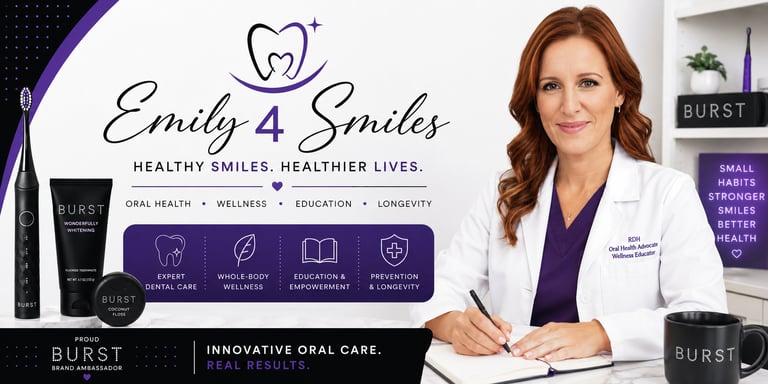
Over time, I have felt increasingly compelled to speak about those issues. I began writing through Emily4Smiles, participating more actively in professional discussions, and learning how to use my voice in advocacy. I do not claim to have every answer. I am still learning and refining my opinions. But I have come to understand that meaningful change requires people who are willing to participate—even when speaking publicly feels uncomfortable.
Recently, I took another step outside my comfort zone and submitted a Special Interest article to the Journal of the California Dental Hygienists’ Association. My article examines dental hygiene autonomy, scope-of-practice restrictions, and how removing unnecessary barriers could allow hygienists to provide care in more settings and reach people who might otherwise go without it.
The article has been submitted for consideration. There is no guarantee that it will be selected for publication, and it may be some time before I receive a response. But submitting it was an accomplishment for me all by itself.
When I look back, my career path does not appear straight or carefully planned. It stretches from a 12-year-old delivering nearly 200 newspapers by bicycle, to a teenage retail manager, an overnight stocker, a Walmart leader responsible for hundreds of employees, a stay-at-home mom, an adult science student, a dental assistant, and finally a registered dental hygienist, educator, writer, and developing advocate.
None of those chapters was wasted.
My family taught me how to work. Retail taught me how to lead, communicate, and remain steady under pressure. Financial hardship taught me that honest work has dignity, even when it is not the work we imagined for ourselves. Motherhood forced me to reconsider how I was spending my time and what I wanted my life to mean. Returning to school taught me that it was not too late to discover a new passion. Dentistry gave me an opportunity to turn that passion into service.
Now I am learning that experience can become a voice—and that a voice can help shape change.
I still do not know exactly where this path will lead. I only know that I want to keep learning, keep caring for my patients, keep speaking up, and keep contributing to a future in which dental hygienists are trusted to use their education, judgment, and skills to improve access to care.
Sometimes growth is not about feeling completely ready. Sometimes it begins when we recognize that everything we have lived through has given us something worth saying—and we finally find the courage to say it.
-Emily Wall, RDH
🍀Hopefully future published author. 🤞


Then and now: One picture depicts Bryan and I in Chico, California, during the summer before we moved to Arizona to begin a new chapter together. The next at my dental hygiene program’s pinning ceremony, where I received the Colgate STAR Award and was chosen by my classmates to speak on behalf of our graduating class. Two very different moments—both part of the journey that brought me here.